Containerization has transformed how we build and deploy software. With tools like Docker and Kubernetes, developers can move faster than ever before.
At the same time, security practices around containers have grown rapidly, image scanning, runtime controls, and Kubernetes policies are now widely discussed and adopted.
And yet, for many teams, container security still feels… complicated.
Not because the knowledge isn’t available. But because it often exists in separate layers rather than a connected flow.
The Nature of the Problem
If you explore container security resources today, you’ll find:
- detailed Docker hardening guides
- Kubernetes security documentation
- vulnerability scanning tools
- compliance frameworks
Each of these is valuable.
But they are often consumed independently, while development itself happens as a continuous lifecycle.
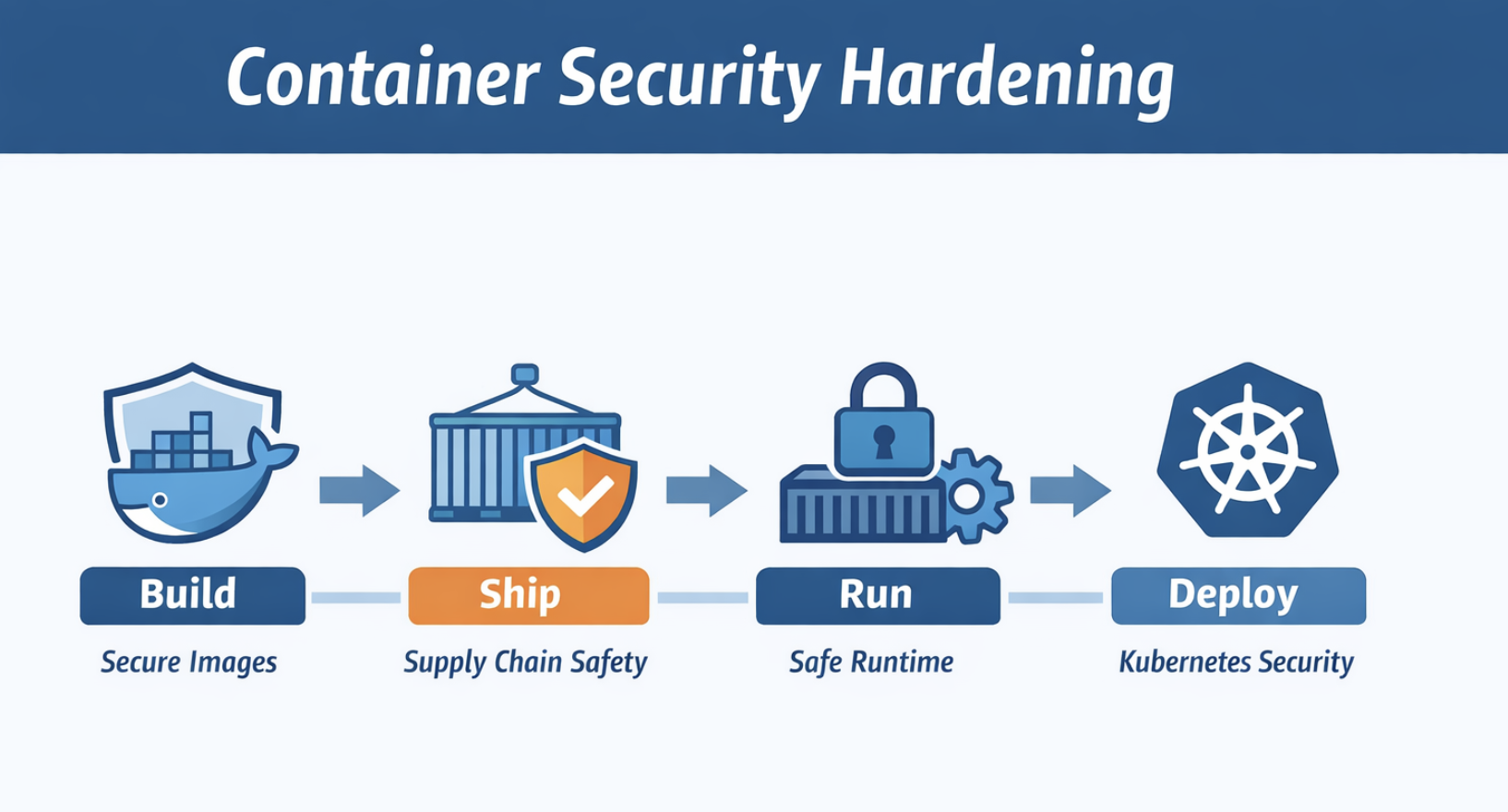
Build → Ship → Run → Deploy
This difference in structure creates subtle friction.
Developers don’t think in isolated domains. They think in pipelines and workflows.
How Security Appears in Practice
In many real-world setups, container security evolves step by step:
Building the image
A base image is selected, dependencies are installed, and the application is packaged. Security considerations may exist, but they are not always explicit:
- base image size and composition
- dependency exposure
- reproducibility of builds
Shipping the image
Images are pushed to registries. Sometimes scanning is introduced here, which is useful but often:
- results are noisy
- prioritization is unclear
- fixes are not integrated into the build process
Running the container
Containers are started with default configurations. These defaults are functional, but not always restrictive:
- processes may run as root
- filesystem access may be broad
- capabilities may be more permissive than necessary
Deploying to Kubernetes
Applications are deployed using manifests in Kubernetes. Security settings are available, but unless explicitly defined, defaults remain:
- no
securityContext - no capability restrictions
- limited network isolation
A More Natural Way to Think About It
Instead of approaching container security as separate topics, it can be helpful to align it with the same lifecycle developers already follow.
1. Build – Image Hardening
Focus on what goes into the image:
- minimal base images
- pinned versions
- multi-stage builds
- avoiding embedded secrets
- generating SBOMs
- scanning for vulnerabilities
2. Ship – Supply Chain Integrity
Focus on trust and traceability:
- verified base images
- image signing
- provenance tracking
- dependency integrity
3. Run – Runtime Hardening
Focus on execution boundaries:
- running as non-root
- read-only filesystems
- reduced Linux capabilities
- avoiding privileged modes
- resource constraints
4. Deploy – Orchestration Security
Focus on Kubernetes-level controls:
runAsNonRootallowPrivilegeEscalation: falsereadOnlyRootFilesystem: true- network policies
- service account restrictions
- Pod Security Standards
A Subtle but Important Shift
When viewed this way, container security becomes less about adding layers of controls and more about making intentional choices at each stage.
It’s not about complexity.
It’s about alignment.
The Role of Simplicity
Many effective security improvements are surprisingly simple:
- choosing a smaller base image
- removing unused packages
- avoiding root execution
- defining explicit runtime constraints
These are small decisions, but they compound.
Over time, they reduce:
- attack surface
- configuration ambiguity
- operational risk
Toward a More Usable Approach
A practical container security approach tends to share a few characteristics:
Developer-friendly
Easy to understand and apply within existing workflows
Layered
Covers image, runtime, and orchestration together
Opinionated (but practical)
Provides clear defaults rather than endless options
Accessible
Works with open-source tools and native platform features
Why This Perspective Matters
Container security is no longer a specialized concern, it’s part of everyday software development.
As systems grow more distributed and automated, the need for clear, usable security practices becomes even more important.
Not more tools. Not more complexity. Just better alignment between:
how systems are built and how they are secured
Closing Thought
A secure containerized system is not defined by how many controls are added, but by how intentionally it is designed. Small, consistent decisions across the lifecycle often matter more than large, reactive changes.
And sometimes, the most effective improvement is simply:
bringing everything into a single, coherent flow
Leave a Reply